

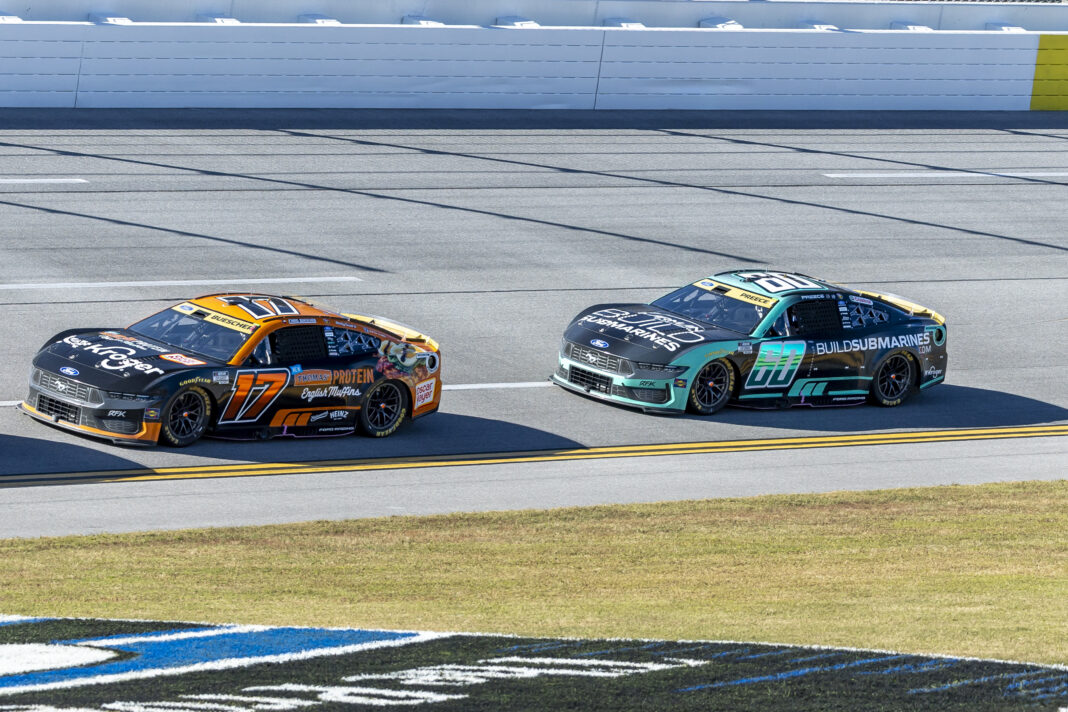


RFK Racing may have given NASCAR the blueprint for fixing one of the biggest problems facing superspeedway racing. During Sunday’s YellaWood 500 at Talladega Superspeedway, Brad Keselowski, Chris Buescher and Ryan Preece took a completely different approach from the rest of the field, and the results were impossible to ignore.
While much of the field focused on saving fuel during the opening stage, the three RFK drivers decided to race at full speed. Their aggressive strategy produced one of the most remarkable stretches of the afternoon and showed fans what superspeedway racing could look like without excessive fuel conservation.
RFK Turned Up the Speed
Keselowski helped lead the charge, with Buescher and Preece joining him at the front. The trio quickly pulled away from the rest of the field, building a lead of more than 40 seconds and threatening to put other competitors a lap down.
The strategy worked so well that the three teammates swept the top three positions in the opening stage. Their performance demonstrated just how much speed the field was sacrificing by prioritizing fuel mileage over racing.
The move also generated excitement among fans who have grown frustrated with the slow pace that fuel-saving strategies can create at Daytona and Talladega.
Could NASCAR Learn From RFK?
RFK’s performance raises an important question about how NASCAR can improve racing at its biggest tracks. Teams are always going to pursue whatever strategy gives them the best chance to win, meaning simply asking drivers to go faster probably will not solve the problem.
However, NASCAR could examine ways to reward aggressive racing and make passing more effective. Ryan Preece even suggested paying drivers for leading laps, arguing that teams currently have greater incentives to save fuel and earn stage points than to push hard early.
Changes to stage lengths, aerodynamic packages or other competition rules could also be considered. The challenge is finding a solution that encourages speed without creating new problems.
A Wake Up Call for NASCAR
RFK’s strategy did not guarantee a victory. Keselowski and Buescher were both caught in a late-race crash, while Preece recovered from earlier damage to finish 13th.
Still, their opening-stage performance may have been one of the weekend’s most important developments.
RFK proved that teams can challenge the fuel-saving approach by taking a calculated risk. NASCAR now has a real-world example of what happens when drivers commit to racing rather than conserving resources.
Whether the sport makes changes remains to be seen, but RFK Racing gave fans a glimpse of a faster, more aggressive Talladega and potentially a path toward improving superspeedway racing.