

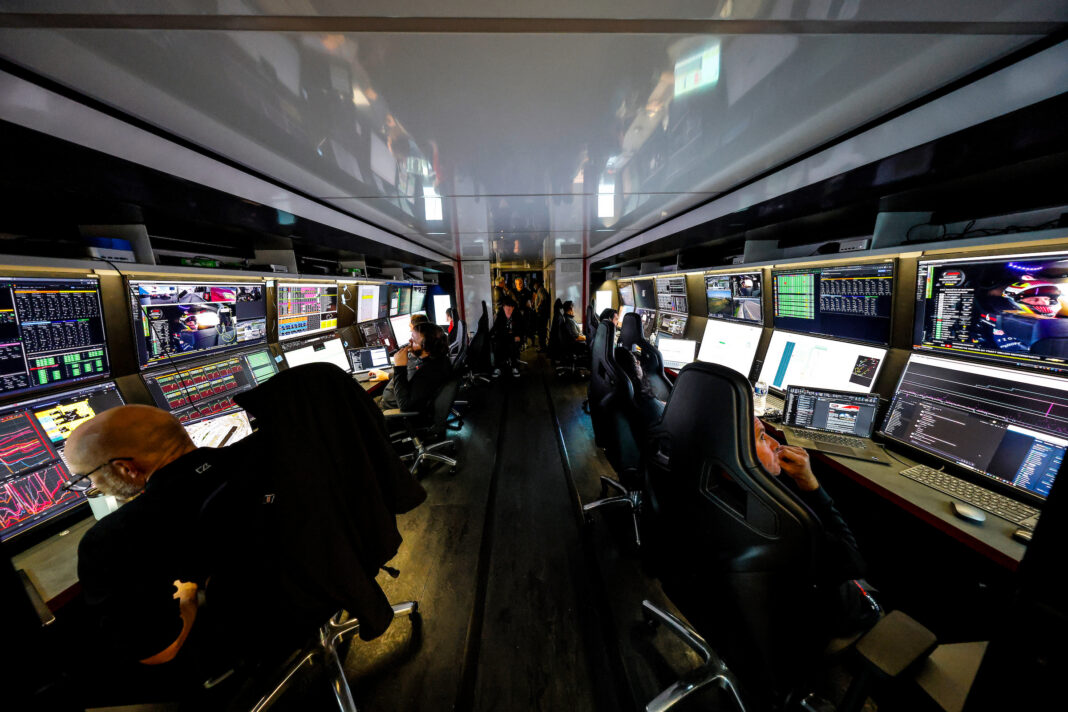


There’s a custom-built technology lab on wheels included on the IMSA schedule that houses some of the hardest-working pieces of equipment at the track.
The IMSA Lenovo Technology Center Powered by AMD travels more than 20,000 miles each year carrying the computing infrastructure behind Race Control, timing and scoring, telemetry and other critical operations.
The mileage alone caught my attention during a tour of the Technology Center at Michelin Raceway Road Atlanta. Twenty thousand miles is roughly 80% of the distance around Earth. The equipment gets transported from circuit to circuit, season after season, and when it arrives, its job is only beginning.
A data center typically has the luxury of staying put. IMSA’s doesn’t. Instead, it has to travel thousands of highway miles carrying sensitive equipment around the country, then arrive ready to keep pace with a live race.
And keeping pace requires processing an almost ridiculous amount of information.
The Technology Center captures more than 10,000 individual data points every second. In the time it takes to read this paragraph, hundreds of thousands more have already come through.
But the number matters less than what IMSA can do with it.
Picture an incident unfolding on track. Race Control isn’t limited to the camera angle you saw on the broadcast. IMSA’s Lenovo and AMD infrastructure can support up to 72 video feeds while bringing video together with timing, scoring and vehicle telemetry in real time.
Officials can look at different sections of the circuit simultaneously, monitor pit lane or continue following a damaged car after it leaves the scene of an incident.
All of that is happening while the race keeps moving.
That’s what makes the speed of the technology so important and why Lenovo sees motorsports as more than a place to put its name.
Racing gives technology very little margin for error. Information is constantly being created, decisions can have immediate consequences, and the infrastructure supporting it all needs to work when it’s called upon.
For Lenovo, that makes IMSA a real-world proving ground.
The same challenge exists outside motorsports: take an enormous amount of information, process it close to where it’s being created and turn it into something useful fast enough to make a decision.
At a racetrack, you can watch that challenge play out in real time.
Lenovo ThinkSystem and ThinkEdge servers sit at the center of IMSA’s mobile operation, with Lenovo laptops used at the front end of Race Control. There’s redundancy built into the system, too. If the primary server has an issue, IMSA has a backup because the cars outside aren’t going to stop and wait for the technology to catch up.
What stood out during the Road Atlanta tour wasn’t simply how much technology IMSA uses. It was how closely that technology has become tied to the act of running a race.
Most fans will never need to know what a ThinkEdge server does or how many data channels a GTP car can produce.
They’ll notice what all of it makes possible.
The incident replayed from another angle. The timing information updating as a battle develops. The officials making decisions while the field continues around the circuit.
And somewhere nearby, a lab trailer full of computing equipment is processing all of it until it’s time to pack up, travel to another racetrack and do it again.