

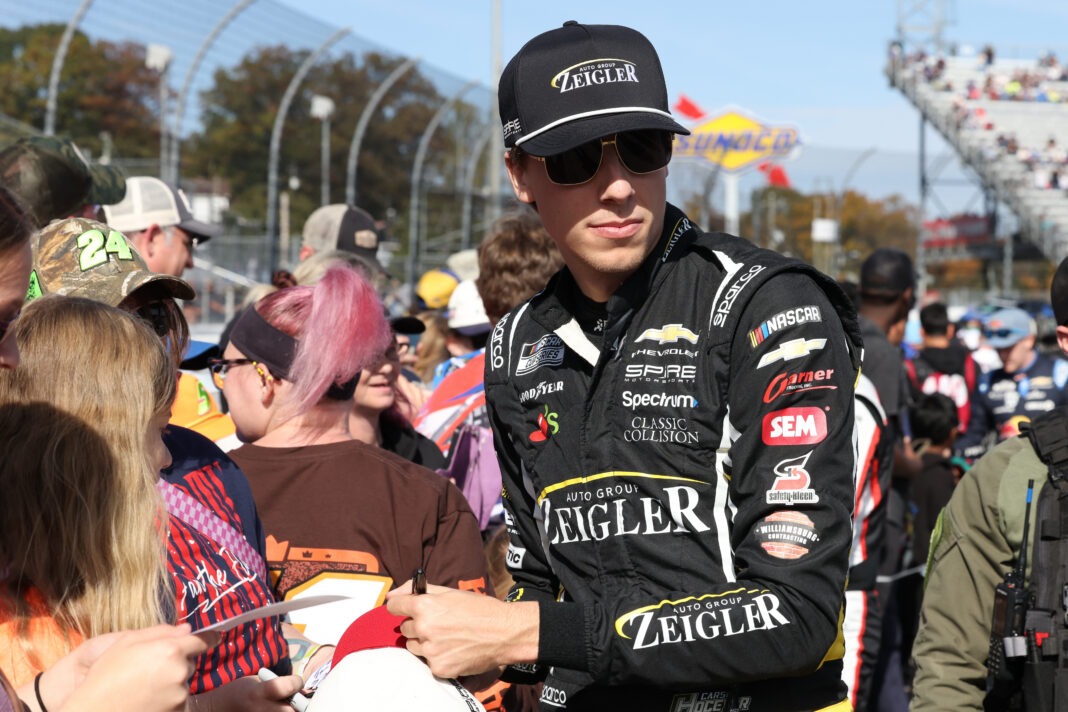


ASCAR has a serious decision to make after Sunday’s race at Martinsville Speedway, and Carson Hocevar could find himself facing consequences.
The Spire Motorsports driver became the center of controversy during the Xfinity 500 after appearing to brake-check Austin Cindric multiple times, ultimately causing significant damage to the No. 2 Ford and ending Cindric’s race early.
And Cindric wasn’t happy about it.
The incident unfolded during Stage 2 after Hocevar spun on his own and reported over the radio that his car was undriveable. On the following restart, Hocevar appeared to slow abruptly in front of Cindric on the frontstretch, then did it again exiting Turn 2.
A third brake check proved to be too much for Cindric, who made contact with the back of Hocevar’s Chevrolet. The damage was severe enough that the No. 2 team had to remove the hood while attempting repairs before eventually taking the car to the garage.
Cindric made his frustration clear over the team radio.
“NASCAR, what are we doing? Like, we’re just weaponizing cars here. I stack on entry with the guy and he has a mental breakdown.”
And he wasn’t the only one questioning Hocevar’s actions. Other teams also expressed frustration over the radio, with Christopher Bell’s crew chief Adam Stevens and Austin Dillon both questioning whether Hocevar’s earlier spin was intentional.
This situation raises an even bigger question about NASCAR’s responsibility to police aggressive driving.
Hocevar has developed a reputation for being one of the most aggressive drivers in the Cup Series. He has been involved in several controversial incidents over the past few seasons, including confrontations with Ryan Blaney and Austin Cindric.
NASCAR has previously handed Hocevar penalties for on-track incidents, including a $50,000 fine and a 25-point deduction in 2024 after an incident with Harrison Burton.
But should repeated brake checks that put another driver’s equipment and safety at risk result in a more serious punishment?
There is a difference between hard racing and deliberately slowing down in front of another competitor. Drivers are expected to race aggressively, but using a race car to retaliate can create dangerous situations for everyone involved.
The timing makes this even more interesting. Martinsville was the final race before the championship finale at Homestead, and Cindric was left with a damaged car and a disappointing result.
NASCAR now has an opportunity to review the footage and decide whether further action is necessary.